Global
 Property Listing

 Dubai
Dubai
Learn how luxury properties in Dubai are valued. Explore premium factors, valuation methods, and what drives pricing in Dubai’s high-end real estate market.
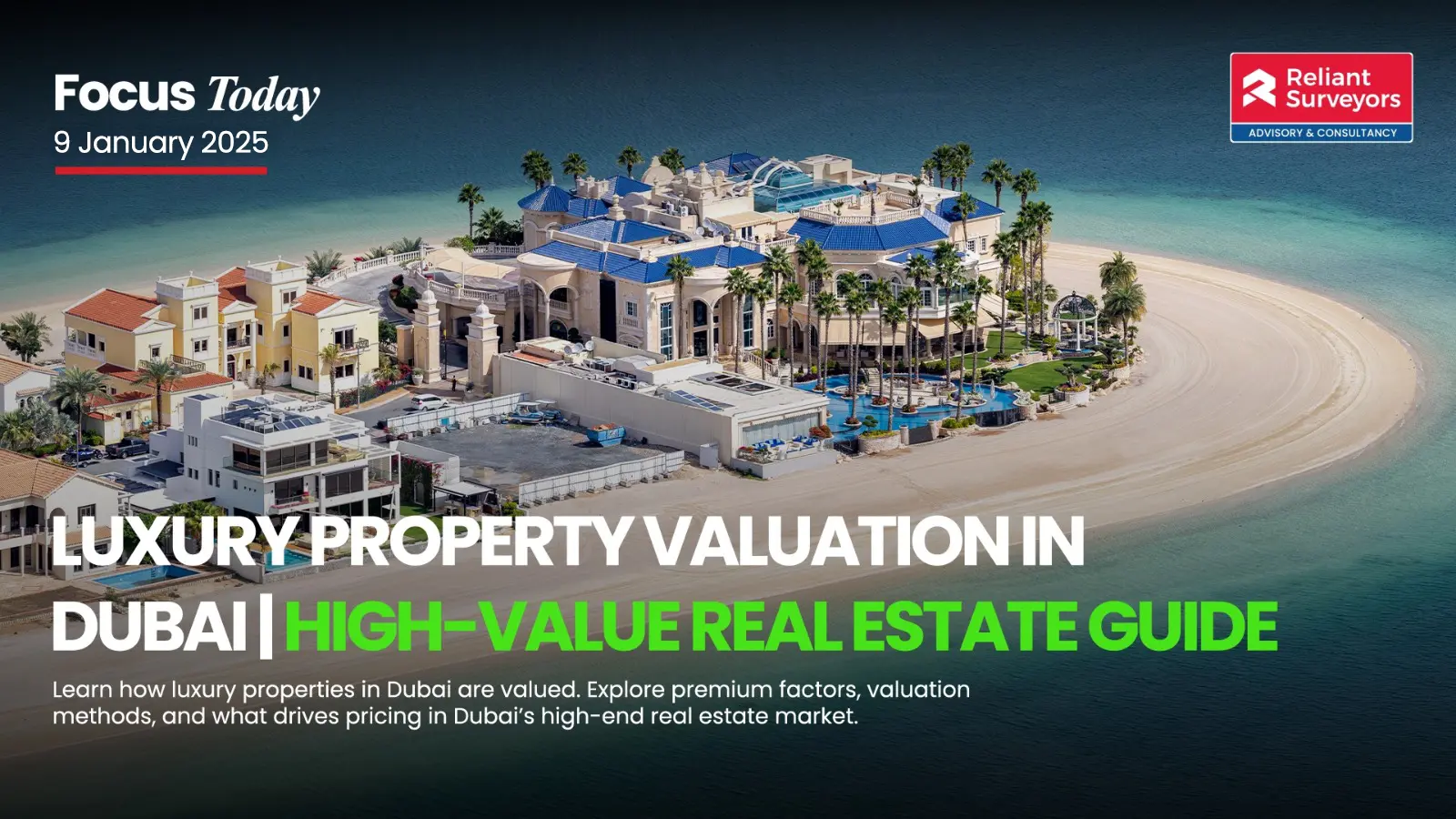
Dubai’s luxury real estate market operates on a different plane. From waterfront mansions and branded residences to ultra-prime penthouses overlooking iconic skylines, value here is shaped by more than location and square footage. For buyers, investors, lenders, and developers, accurate luxury property valuation in Dubai standards are critical to protecting capital and making informed decisions in this high-stakes segment.
Luxury assets demand a valuation approach that recognises exclusivity, scarcity, and long-term desirability. This guide breaks down how luxury property valuation in Dubai is conducted for premium real estate, what drives value at the top end of the market, and why choosing the right valuation partner matters.
Understanding Luxury Real Estate in Dubai
Luxury properties in Dubai typically sit within prime or ultra-prime segments. These include beachfront villas, signature penthouses, branded residences, golf course estates, and landmark developments in areas such as Palm Jumeirah, Downtown Dubai, Dubai Marina, Emirates Hills, and select waterfront communities.
Unlike mass-market housing, luxury assets are often limited in supply, highly customised, influenced by global buyer sentiment, and sensitive to design, branding, and lifestyle positioning. As a result, luxury property valuation valuation Dubai for luxury properties goes far beyond conventional price-per-square-foot calculations.
Key Factors That Drive Luxury Property Valuation in Dubai
1. Prime Location and Micro-Market Positioning
In luxury valuation, location is not just about the area, but the exact positioning within it. Waterfront orientation, unobstructed views, proximity to landmarks, and exclusivity of access all play a decisive role.
A penthouse facing Burj Khalifa or a beachfront villa with private sea access will be valued significantly higher than comparable properties without these advantages, even within the same development.
2. Architectural Design and Build Quality
High-value real estate places strong emphasis on design integrity and construction standards.
Valuers assess architectural uniqueness, quality of materials and finishes, layout efficiency, ceiling heights, and custom-built features. Luxury buyers consistently pay premiums for properties that demonstrate timeless design rather than trend-driven aesthetics.
3. Brand Association and Developer Reputation
Branded residences and projects developed by established names often command valuation premiums. International hospitality brands, renowned architects, and trusted developers enhance both market confidence and long-term value.
For any real estate valuation company in Dubai, developer credibility remains a critical consideration when assessing luxury assets.
4. Amenities and Lifestyle Offering
In the luxury segment, amenities are not add-ons. They are core value drivers.
Private beach access, concierge services, wellness facilities, smart-home integration, and privacy-focused security infrastructure directly influence desirability, rental demand, and resale performance.
5. Scarcity and Market Demand
True luxury is defined by limited availability. Properties with unique characteristics or restricted supply often experience stronger capital preservation and long-term appreciation.
Professional valuers analyse buyer demand, global investor activity, and pricing behaviour to determine how scarcity impacts property valuation in luxury property.
Valuation Methods Used for Luxury Properties
Luxury real estate requires a refined application of standard valuation approaches, often blending multiple methods.
Comparable Sales Method
Recent high-end transactions are analysed and adjusted for views, branding, layout, exclusivity, and amenities. Precision here is essential, as no two luxury properties are truly identical.
Income Approach
For assets with rental potential, valuers assess achievable rental yields, occupancy demand, and long-term income sustainability.
Cost Approach
Used selectively for bespoke villas and unique residences, this method evaluates replacement cost, land value, and construction quality.
A top valuation firm in UAE applies these methods with judgment, not formulas.
The Role of RICS Standards in Luxury Valuation
RICS-compliant valuations are widely recognised by banks, institutional investors, and international stakeholders. For luxury properties, adherence to global standards ensures transparency, credibility, and lender acceptance.
RICS-aligned property valuation Dubai frameworks provide consistency across borders and confidence across transaction types.
Why Independent Valuation Matters in the Luxury Segment
Luxury transactions involve significant financial exposure. Independent valuation ensures objectivity, supports negotiations, and mitigates risk for buyers, sellers, and lenders alike.
An experienced property valuation provides clarity where pricing can otherwise be subjective.
Final Thoughts
Luxury real estate valuation in Dubai is a specialised discipline. It requires deep market insight, international standards, and an understanding of what truly drives value at the highest level.
In a market defined by ambition and global attention, accurate property valuation in Dubai is not optional. It is foundational.
Reliant Surveyors: Trusted Valuation Expertise
With over 48 years of valuation expertise, 11,000+ clients worldwide, and 10,000+ global valuations completed, Reliant Surveyors stands among the most trusted names in high-value real estate advisory.
As a leading luxury property valuation company in Dubai, Reliant delivers RICS-compliant valuations for luxury residential assets, branded developments, and complex premium portfolios. Our approach combines technical precision, deep local intelligence, and global best practices to support confident decision-making across acquisitions, financing, and strategic asset planning.
When accuracy, credibility, and long-term value matter, Reliant Surveyors provides valuation clarity you can rely on.
FAQ
1. How is luxury property valuation different from standard property valuation in Dubai?
Luxury property valuation in Dubai goes beyond price-per-square-foot analysis. It considers factors such as exclusivity, architectural design, brand association, views, amenities, scarcity, and long-term desirability, which are not as critical in standard residential valuations.
2. What factors most influence luxury real estate valuation in Dubai?
Key factors include prime micro-location, waterfront or landmark views, build quality, developer reputation, branded residence status, lifestyle amenities, and limited supply. Global buyer demand and long-term capital preservation potential also play a major role.
3. Are branded residences valued higher in Dubai’s luxury market?
Yes, branded residences often command property valuation premiums due to brand credibility, service standards, global recognition, and higher buyer confidence. Valuers assess the strength of the brand, operator involvement, and long-term demand sustainability when determining value.
4. Which valuation methods are used for luxury properties in Dubai?
Luxury properties are typically valued using a combination of the Comparable Sales Method, Income Approach, and Cost Approach. Valuers apply professional judgment to adjust for uniqueness, exclusivity, and market positioning rather than relying on formulas alone.
5. Why are RICS standards important for luxury property valuation in Dubai?
RICS standards ensure valuations are transparent, internationally recognised, and accepted by banks and institutional investors. For luxury assets, RICS compliance provides credibility and consistency, especially in high-value transactions and cross-border investments.
6. When is an independent luxury property valuation necessary in Dubai?
Independent valuation is essential for buying or selling high-value properties, mortgage financing, refinancing, legal matters, financial reporting, and investment planning. It helps mitigate risk, supports negotiations, and ensures decisions are based on objective market evidence.